
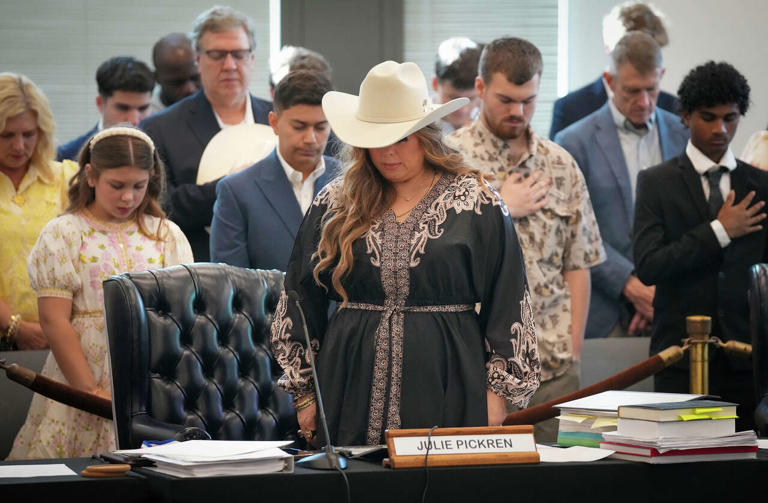
 The Texas State Board of Education has approved new public school standards that integrate biblical teachings into classroom instruction, making Christianity a central component of education for the state's 5.5 million public school students.Following months of heated debate, the Republican-controlled board voted 9-5 on Friday to adopt a mandatory reading list for every grade level before approving revised social studies standards for kindergarten through eighth grade. The new curriculum embeds biblical concepts and figures and is regarded as one of the most far-reaching efforts in the United States to require the teaching of Christianity in public schools. The standards, which will shape textbooks and statewide examinations, are expected to be introduced in phases beginning with elementary schools in the 2030-2031 academic year.Supporters said the changes are intended to promote Judeo-Christian values and provide students with a stronger understanding of American history and moral principles. The curriculum includes required lessons on biblical figures such as Jesus, Abraham and Moses."We are bringing the Bible back into schools this week for the first time in 60 years," State Board of Education member Brandon Hall, a Republican representing Aledo, said during a prayer session outside the hearing. Not all Republican board members supported the move. Evelyn Brooks of Frisco voted against the required reading list, arguing that it would reduce teachers' autonomy in selecting classroom materials.Critics, however, said the new standards present history and literature through a predominantly Christian perspective while reducing attention given to racial, cultural and religious diversity. They also argued that the changes could violate the constitutional principle separating church and state."Texas is telling millions of children that one religion deserves the government's seal of approval, while everyone else is an afterthought," said Annie Laurie Gaylor, president of the Freedom From Religion Foundation. "That's government-sponsored religious favoritism - and the First Amendment strictly forbids it."Concerns were also raised by Jewish and Muslim advocacy groups over how their faiths are portrayed in the revised curriculum. Jewish leaders warned that the pairing of certain biblical texts with Holocaust lessons could foster antisemitism in classrooms.Muslim advocates also criticised the curriculum for linking Islam primarily with violence. The standards require students to study topics including the "Muslim invasion" of Christian territories during the Crusades and the role of "jihad" in 21st-century terrorism, while omitting significant Muslim contributions to science and mathematics."You have tied Muslim history to warfare, piracy and radicalism, then voted on purpose to strip out the algebra and astronomy contributions Muslims have made," said Amina Ishaq of the Fort Bend Coalition for Justice. "You have decided which children inherit greatness and which only inherit suspicion."The curriculum overhaul follows a series of recent measures by Texas lawmakers to expand the role of religion in public education, including legislation requiring the Ten Commandments to be displayed in every classroom and the introduction of state-developed, Bible-infused "Bluebonnet" instructional materials. Unlike the optional Bluebonnet textbooks, however, the newly approved standards will be mandatory for all Texas public schools, including charter schools.Texas also becomes the only U.S. state to prescribe its own statewide literature reading requirements instead of allowing school districts or teachers to determine reading lists. Depending on grade level, students will be required to study up to 30 prescribed texts, including approximately a dozen passages from the Bible. Lessons will range from the story of David and Goliath in second grade to the Book of Job in tenth grade. Many educators opposed the new reading requirements, arguing that the prescribed list is too extensive to be completed within a single school year."The lists will eat up weeks of valuable instructional time," said Diane Miller of the Texas Council of Teachers of English Language Arts. "It's a bridge too far to cross." The revised social studies curriculum also introduces significant changes, placing greater emphasis on historical knowledge while reducing skills-based learning, such as creating timelines and learning cardinal directions.Under the new standards, younger students will encounter more advanced historical topics earlier than before. First-grade pupils will study slavery and the American Civil War, while second graders will learn about the American Revolution and the War of 1812. Third-grade students will cover ancient Israel, Greece and Rome, as well as the Ten Commandments.The drafting process also attracted criticism after an appointed panel of nine content advisers assumed a larger role than classroom teachers in shaping the curriculum. Some advisers were accused of having close ties to conservative organisations and think tanks, while Democrats alleged that one adviser had received improper outside payments. During the final deliberations, board members approved hundreds of amendments, including additional references to evangelist Billy Graham and lessons examining the negative impacts of divorce.Debates over race also featured prominently, with Republicans removing language stating that Africans were enslaved in the United States "because of the color of their skin." However, a bipartisan majority retained wording recognising slavery as a central cause of the American Civil War. The board concluded its work without completing deliberations on high school social studies standards, postponing further consideration until September.The post Texas becomes first US state to require students read the Bible with required literary list appeared first on Linda Ikeji Blog.

0 Comments