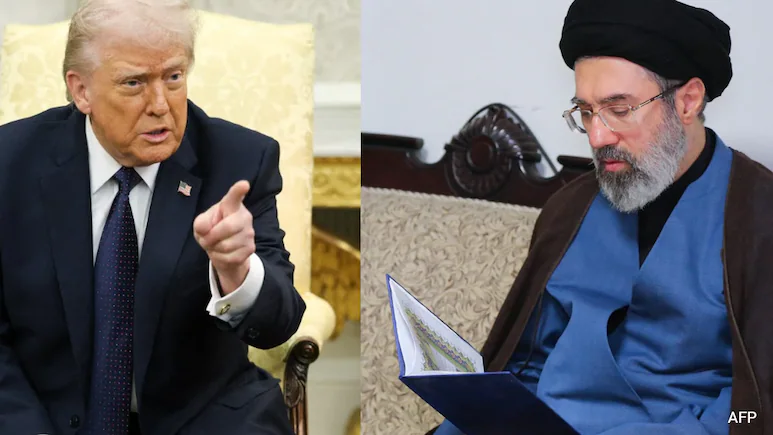
Washington and Tehran have "largely negotiated" a memorandum of understanding on a peace deal that would reopen the blockaded Strait of Hormuz, U.S. President Donald Trump announced.The disclosure has significantly heightened global expectations that an imminent breakthrough could end the three-month-old Middle East war. According to Trump, the emerging agreement, which is currently being brokered by Pakistan, would fully reopen the vital maritime passage. The closure of the strait has triggered a severe global energy crisis since the United States and Israel launched military operations against Iran in February."Final aspects and details of the Deal are currently being discussed, and will be announced shortly," Trump wrote on Truth Social.United States and Iranian media outlets report that the draft memorandum outlines a phased framework aimed at halting months of active combat and stabilizing global markets.Under the initial phase of the agreement, the parties would pursue the immediate termination of the war, an end to the U.S. maritime blockade on Iranian ports, and the immediate reopening of the Strait of Hormuz.The second phase would involve the release of roughly $25 billion in Iranian assets currently frozen in overseas banks under global sanction regimes. The final phase would trigger the activation of a strict 30-to-60-day negotiating window specifically designated to address Irans highly enriched uranium stockpile and broader nuclear program.U.S. Secretary of State Marco Rubio, speaking during a diplomatic visit to India, confirmed that progress has been made on an outline to ensure the waterway reopens "without tolls," though he emphasized it remains subject to full Iranian compliance.Despite Trump's optimism, deep diplomatic and domestic hurdles remain unresolved on both sides, particularly regarding the question of waterway control. While Washington expects completely open, toll-free straits, Iran's semi-official Fars News Agency, which is allied with the Islamic Revolutionary Guard Corps, strongly pushed back against Trump's narrative.Fars reported that the management, routing, and permitting of the shipping lane will remain under the strict monopoly and discretion of the Islamic Republic, calling Trumps claims of an imminent finalized pact "inconsistent with reality."Concurrently, Iranian Foreign Ministry spokesperson Esmail Baghaei noted that while disputes are narrowing through international mediators, Tehrans immediate priorities remain securing guarantees against future U.S. strikes and ensuring a cessation of hostilities in Lebanon.The conflict has levied a heavy toll on the global economy and triggered adjacent regional theaters, with Brent crude oil trading at $103.50 per barrel, representing a 43% surge since hostilities began in February. Furthermore, the Abu Dhabi National Oil Company warns that full maritime flows will not normalize until the first or second quarter of 2027, even if an immediate truce is signed, while on the ground, Israeli forces have crossed the border into Lebanon to engage the Iranian-backed Hezbollah militia.The potential deal has sparked fierce political blowback in Israel, where prominent politician Benny Gantz labeled any agreement that binds Israel to a ceasefire in Lebanon a "strategic mistake."Israeli media reports indicate Prime Minister Benjamin Netanyahu personally informed President Trump that Israel demands absolute freedom to act independently against security threats in Lebanon regardless of any Washington-Tehran pact, which is a condition Netanyahus team claims Trump accepted.The domestic political stakes remain high for Trump, whose approval ratings have absorbed damage from soaring domestic fuel, fertilizer, and food costs.The President bypassed attending his son's wedding over the weekend to manage the crisis from Washington, holding a flurry of high-level consultations with leaders from Saudi Arabia, Qatar, the United Arab Emirates, Egypt, Jordan, Turkey, and Pakistan.Pakistani security sources indicate that if the current memorandum is successfully finalized by the United States and receives the approval of Iranian Supreme Leader Ayatollah Mojtaba Khamenei, secondary face-to-face implementation talks could begin immediately following the conclusion of the Muslim Eid holiday. The post Iran Peace deal largely negotiate would reopen Strait of HormuzTrump appeared first on Linda Ikeji Blog.


0 Comments